Sunday, September 18, 2005

Environmental Injustice in Detroit


Hazards are in the air for Michigan asthmatics
The Severstal steel plant, formerly Rouge Steel, is one source of soot, which agravates asthma.

Photo taken on August 2, 2005. (The Detroit News/John T. Greilick)

By Gregg Krupa / The Detroit News

The Metro Detroit and Ann Arbor region ranks with places such as the Los Angeles basin and the urban corridor between New York City and Washington, D.C, when it comes to the presence of soot -- tiny, airborne particles of pollution.

But there is concern that the standard the EPA has set for soot is too low. In June, the agency's own scientists advised that the EPA should target smaller concentrations of the particles in the air because they threaten good health -- especially for people who have asthma and cardiovascular diseases.

"A stricter standard is very important, and so is enforcement," said Marie O'Neill, the Robert Wood Johnson Health & Society scholar at the University of Michigan. "If we achieved a really significant reduction in air pollution as a result, you'd see a reduction in hospital visits for asthma, absenteeism for schoolchildren and longer, healthier lives for people."

O'Neill is one of 100 independent doctors and scientists who signed a letter in March urging the agency to regulate lower concentrations of particles in the air.

The EPA uses the measurement of "micrograms per meter cubed" to regulate the amount of particles in the air. Currently, the agency will begin enforcement action -- anything from requiring remedial plans, at first, to fines if goals are not met -- when the 24-hour average limit reaches 65 micrograms per cubic meter and the annual average limit reaches 15 micrograms per cubic meter.

The 100 doctors and scientists urged the agency to lower the thresholds for enforcement to 25 to 35 micrograms per cubic meter for the 24-hour standard, and 12 to 14 micrograms per cubic meter for the annual standard.

Under the Clean Air Act, the EPA is charged with reviewing health standards as frequently as every five years.
"Much new high-quality research into the health effects of particulate air pollution has been completed since EPA's last review of the air quality standards in 1997," the doctors and scientists wrote. "Based on these data, we believe that strengthening of ... the fine particle standards is now needed to protect public health."

Those struggling with asthma say it is easy to notice when the air is cleaner.

"We went to Florida and Georgia and spent about 14 days there recently. My son did not use his inhaler at all," said Yasser Maisari, a pharmacist from Dearborn. "There was a lot of hot air there, and we did a lot of walking."

http://www.detnews.com/2005/health/0509/18/A13-318223.htm

Posted by Picasa

Public Health Nightmare


Photos by John T. Greilick / The Detroit News

Gasping For Air

Sunday, September 18, 2005
The Detroit News

Sharnay Duncan: The 4-year-old uses a mask for her daily nebulizer treatment. Her mother, Shari Duncan, 45, of Detroit and her six children all have asthma. "I usually have to choose between medication for my kids or for me," Shari Duncan says.

Gasping for airKate Safford lives by obsessing about her disease. 09/18/05

Hazards are in the air for Michigan asthmaticsThe Metro Detroit and Ann Arbor region ranks with places such as the Los Angeles basin and the urban corridor between New York City and Washington, D.C, when it comes to the presence of soot -- tiny, airborne particles of pollution. 09/18/05

More asthma patients black, low-incomeDETROIT -- For years, all Shari Duncan knew was that she had "a lung ailment." 09/18/05

Managing asthma in childrenBack-to-school time is ideal for addressing issues of managing the disease with your children. Asthma is the leading cause of preventable school absences, and while 17 percent of all pubic school students have asthma, only about 28 percent of schools educate students about how to cope with the disease. 09/18/05

Common asthma triggers 09/18/05

http://www.detnews.com/2005/health/0509/18/index.htm

Posted by Picasa

Spin Doctors At It Again.........

President Discusses Hurricane Relief in Address to the Nation

Jackson Square (wonder why he didn't speak from Congo Square)
New Orleans, Louisiana

8:02 P.M. CDT
THE PRESIDENT: Good evening. I'm speaking to you from the city of New Orleans -- nearly empty, still partly under water, and waiting for life and hope to return. Eastward from Lake Pontchartrain, across the Mississippi coast, to Alabama into Florida, millions of lives were changed in a day by a cruel and wasteful storm.

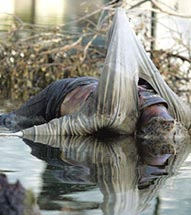
In the aftermath, we have seen fellow citizens left stunned and uprooted, searching for loved ones, and grieving for the dead, and looking for meaning in a tragedy that seems so blind and random. We've also witnessed the kind of desperation no citizen of this great and generous nation should ever have to know -- fellow Americans calling out for food and water, vulnerable people left at the mercy of criminals who had no mercy, and the bodies of the dead lying uncovered and untended in the street.

These days of sorrow and outrage have also been marked by acts of courage and kindness that make all Americans proud. Coast Guard and other personnel rescued tens of thousands of people from flooded neighborhoods. Religious congregations and families have welcomed strangers as brothers and sisters and neighbors. In the community of Chalmette, when two men tried to break into a home, the owner invited them to stay -- and took in 15 other people who had no place to go. At Tulane Hospital for Children, doctors and nurses did not eat for days so patients could have food, and eventually carried the patients on their backs up eight flights of stairs to helicopters.

Many first responders were victims themselves, wounded healers, with a sense of duty greater than their own suffering. When I met Steve Scott of the Biloxi Fire Department, he and his colleagues were conducting a house-to-house search for survivors. Steve told me this: "I lost my house and I lost my cars, but I still got my family ... and I still got my spirit."
Across the Gulf Coast, among people who have lost much, and suffered much, and given to the limit of their power, we are seeing that same spirit -- a core of strength that survives all hurt, a faith in God no storm can take away, and a powerful American determination to clear the ruins and build better than before.

Tonight so many victims of the hurricane and the flood are far from home and friends and familiar things. You need to know that our whole nation cares about you, and in the journey ahead you're not alone. To all who carry a burden of loss, I extend the deepest sympathy of our country. To every person who has served and sacrificed in this emergency, I offer the gratitude of our country. And tonight I also offer this pledge of the American people: Throughout the area hit by the hurricane, we will do what it takes, we will stay as long as it takes, to help citizens rebuild their communities and their lives. And all who question the future of the Crescent City need to know there is no way to imagine America without New Orleans, and this great city will rise again.

The work of rescue is largely finished; the work of recovery is moving forward. In nearly all of Mississippi, electric power has been restored. Trade is starting to return to the Port of New Orleans, and agricultural shipments are moving down the Mississippi River. All major gasoline pipelines are now in operation, preventing the supply disruptions that many feared. The breaks in the levees have been closed, the pumps are running, and the water here in New Orleans is receding by the hour. Environmental officials are on the ground, taking water samples, identifying and dealing with hazardous debris, and working to get drinking water and waste water treatment systems operating again. And some very sad duties are being carried out by professionals who gather the dead, treat them with respect, and prepare them for their rest.
In the task of recovery and rebuilding, some of the hardest work is still ahead, and it will require the creative skill and generosity of a united country.

Our first commitment is to meet the immediate needs of those who had to flee their homes and leave all their possessions behind. For these Americans, every night brings uncertainty, every day requires new courage, and in the months to come will bring more than their fair share of struggles.

The Department of Homeland Security is registering evacuees who are now in shelters and churches, or private homes, whether in the Gulf region or far away. I have signed an order providing immediate assistance to people from the disaster area. As of today, more than 500,000 evacuee families have gotten emergency help to pay for food, clothing, and other essentials. Evacuees who have not yet registered should contact FEMA or the Red Cross.

We need to know who you are, because many of you will be eligible for broader assistance in the future. Many families were separated during the evacuation, and we are working to help you reunite. Please call this number: 1-877-568-3317 -- that's 1-877-568-3317 -- and we will work to bring your family back together, and pay for your travel to reach them.

In addition, we're taking steps to ensure that evacuees do not have to travel great distances or navigate bureaucracies to get the benefits that are there for them. The Department of Health and Human Services has sent more than 1,500 health professionals, along with over 50 tons of medical supplies -- including vaccines and antibiotics and medicines for people with chronic conditions such as diabetes. The Social Security Administration is delivering checks.

The Department of Labor is helping displaced persons apply for temporary jobs and unemployment benefits. And the Postal Service is registering new addresses so that people can get their mail.

To carry out the first stages of the relief effort and begin rebuilding at once, I have asked for, and the Congress has provided, more than $60 billion. This is an unprecedented response to an unprecedented crisis, which demonstrates the compassion and resolve of our nation.
Our second commitment is to help the citizens of the Gulf Coast to overcome this disaster, put their lives back together, and rebuild their communities. Along this coast, for mile after mile, the wind and water swept the land clean.

In Mississippi, many thousands of houses were damaged or destroyed. In New Orleans and surrounding parishes, more than a quarter-million houses are no longer safe to live in. Hundreds of thousands of people from across this region will need to find longer-term housing.
Our goal is to get people out of the shelters by the middle of October. So we're providing direct assistance to evacuees that allows them to rent apartments, and many already are moving into places of their own. A number of states have taken in evacuees and shown them great compassion -- admitting children to school, and providing health care. So I will work with the Congress to ensure that states are reimbursed for these extra expenses.

In the disaster area, and in cities that have received huge numbers of displaced people, we're beginning to bring in mobile homes and trailers for temporary use. To relieve the burden on local health care facilities in the region, we're sending extra doctors and nurses to these areas. We're also providing money that can be used to cover overtime pay for police and fire departments while the cities and towns rebuild.

Near New Orleans, and Biloxi, and other cities, housing is urgently needed for police and firefighters, other service providers, and the many workers who are going to rebuild these cities. Right now, many are sleeping on ships we have brought to the Port of New Orleans -- and more ships are on their way to the region. And we'll provide mobile homes, and supply them with basic services, as close to construction areas as possible, so the rebuilding process can go forward as quickly as possible.

And the federal government will undertake a close partnership with the states of Louisiana and Mississippi, the city of New Orleans, and other Gulf Coast cities, so they can rebuild in a sensible, well-planned way. Federal funds will cover the great majority of the costs of repairing public infrastructure in the disaster zone, from roads and bridges to schools and water systems. Our goal is to get the work done quickly. And taxpayers expect this work to be done honestly and wisely -- so we'll have a team of inspectors general reviewing all expenditures.

In the rebuilding process, there will be many important decisions and many details to resolve, yet we're moving forward according to some clear principles. The federal government will be fully engaged in the mission, but Governor Barbour, Governor Blanco, Mayor Nagin, and other state and local leaders will have the primary role in planning for their own future. Clearly, communities will need to move decisively to change zoning laws and building codes, in order to avoid a repeat of what we've seen. And in the work of rebuilding, as many jobs as possible should go to the men and women who live in Louisiana, Mississippi, and Alabama.

Our third commitment is this: When communities are rebuilt, they must be even better and stronger than before the storm. Within the Gulf region are some of the most beautiful and historic places in America. As all of us saw on television, there's also some deep, persistent poverty in this region, as well. That poverty has roots in a history of racial discrimination, which cut off generations from the opportunity of America.

We have a duty to confront this poverty with bold action. So let us restore all that we have cherished from yesterday, and let us rise above the legacy of inequality. When the streets are rebuilt, there should be many new businesses, including minority-owned businesses, along those streets. When the houses are rebuilt, more families should own, not rent, those houses. When the regional economy revives, local people should be prepared for the jobs being created.
Americans want the Gulf Coast not just to survive, but to thrive; not just to cope, but to overcome. We want evacuees to come home, for the best of reasons -- because they have a real chance at a better life in a place they love.

When one resident of this city who lost his home was asked by a reporter if he would relocate, he said, "Naw, I will rebuild -- but I will build higher." That is our vision for the future, in this city and beyond: We'll not just rebuild, we'll build higher and better. To meet this goal, I will listen to good ideas from Congress, and state and local officials, and the private sector. I believe we should start with three initiatives that the Congress should pass.

Tonight I propose the creation of a Gulf Opportunity Zone, encompassing the region of the disaster in Louisiana and Mississippi and Alabama. Within this zone, we should provide immediate incentives for job-creating investment, tax relief for small businesses, incentives to companies that create jobs, and loans and loan guarantees for small businesses, including minority-owned enterprises, to get them up and running again. It is entrepreneurship that creates jobs and opportunity; it is entrepreneurship that helps break the cycle of poverty; and we will take the side of entrepreneurs as they lead the economic revival of the Gulf region.

I propose the creation of Worker Recovery Accounts to help those evacuees who need extra help finding work. Under this plan, the federal government would provide accounts of up to $5,000, which these evacuees could draw upon for job training and education to help them get a good job, and for child care expenses during their job search.

And to help lower-income citizens in the hurricane region build new and better lives, I also propose that Congress pass an Urban Homesteading Act. Under this approach, we will identify property in the region owned by the federal government, and provide building sites to low-income citizens free of charge, through a lottery. In return, they would pledge to build on the lot, with either a mortgage or help from a charitable organization like Habitat for Humanity. Home ownership is one of the great strengths of any community, and it must be a central part of our vision for the revival of this region.

In the long run, the New Orleans area has a particular challenge, because much of the city lies below sea level. The people who call it home need to have reassurance that their lives will be safer in the years to come. Protecting a city that sits lower than the water around it is not easy, but it can, and has been done. City and parish officials in New Orleans, and state officials in Louisiana will have a large part in the engineering decisions to come. And the Army Corps of Engineers will work at their side to make the flood protection system stronger than it has ever been.

The work that has begun in the Gulf Coast region will be one of the largest reconstruction efforts the world has ever seen. When that job is done, all Americans will have something to be very proud of -- and all Americans are needed in this common effort. It is the armies of compassion -- charities and houses of worship, and idealistic men and women -- that give our reconstruction effort its humanity. They offer to those who hurt a friendly face, an arm around the shoulder, and the reassurance that in hard times, they can count on someone who cares. By land, by sea, and by air, good people wanting to make a difference deployed to the Gulf Coast, and they've been working around the clock ever since.

The cash needed to support the armies of compassion is great, and Americans have given generously. For example, the private fundraising effort led by former Presidents Bush and Clinton has already received pledges of more than $100 million. Some of that money is going to the Governors to be used for immediate needs within their states. A portion will also be sent to local houses of worship to help reimburse them for the expense of helping others. This evening the need is still urgent, and I ask the American people to continue donating to the Salvation Army, the Red Cross, other good charities, and religious congregations in the region.

citizens in the Gulf area. So I've asked USA Freedom Corps to create an information clearinghouse, available at usafreedomcorps.gov, so that families anywhere in the country can find opportunities to help families in the region, or a school can support a school. And I challenge existing organizations -- churches, and Scout troops, or labor union locals to get in touch with their counterparts in Mississippi, Louisiana, or Alabama, and learn what they can do to help. In this great national enterprise, important work can be done by everyone, and everyone should find their role and do their part.

The government of this nation will do its part, as well. Our cities must have clear and up-to-date plans for responding to natural disasters, and disease outbreaks, or a terrorist attack, for evacuating large numbers of people in an emergency, and for providing the food and water and security they would need. In a time of terror threats and weapons of mass destruction, the danger to our citizens reaches much wider than a fault line or a flood plain. I consider detailed emergency planning to be a national security priority, and therefore, I've ordered the Department of Homeland Security to undertake an immediate review, in cooperation with local counterparts, of emergency plans in every major city in America.

I also want to know all the facts about the government response to Hurricane Katrina. The storm involved a massive flood, a major supply and security operation, and an evacuation order affecting more than a million people. It was not a normal hurricane -- and the normal disaster relief system was not equal to it. Many of the men and women of the Coast Guard, the Federal Emergency Management Agency, the United States military, the National Guard, Homeland Security, and state and local governments performed skillfully under the worst conditions.

Yet the system, at every level of government, was not well-coordinated, and was overwhelmed in the first few days. It is now clear that a challenge on this scale requires greater federal authority and a broader role for the armed forces -- the institution of our government most capable of massive logistical operations on a moment's notice.

Four years after the frightening experience of September the 11th, Americans have every right to expect a more effective response in a time of emergency. When the federal government fails to meet such an obligation, I, as President, am responsible for the problem, and for the solution. So I've ordered every Cabinet Secretary to participate in a comprehensive review of the government response to the hurricane. This government will learn the lessons of Hurricane Katrina.

We're going to review every action and make necessary changes, so that we are better prepared for any challenge of nature, or act of evil men, that could threaten our people.
The United States Congress also has an important oversight function to perform. Congress is preparing an investigation, and I will work with members of both parties to make sure this effort is thorough.

In the life of this nation, we have often been reminded that nature is an awesome force, and that all life is fragile. We're the heirs of men and women who lived through those first terrible winters at Jamestown and Plymouth, who rebuilt Chicago after a great fire, and San Francisco after a great earthquake, who reclaimed the prairie from the Dust Bowl of the 1930s. Every time, the people of this land have come back from fire, flood, and storm to build anew -- and to build better than what we had before. Americans have never left our destiny to the whims of nature -- and we will not start now.

These trials have also reminded us that we are often stronger than we know -- with the help of grace and one another. They remind us of a hope beyond all pain and death, a God who welcomes the lost to a house not made with hands. And they remind us that we're tied together in this life, in this nation -- and that the despair of any touches us all.

I know that when you sit on the steps of a porch where a home once stood, or sleep on a cot in a crowded shelter, it is hard to imagine a bright future. But that future will come. The streets of Biloxi and Gulfport will again be filled with lovely homes and the sound of children playing. The churches of Alabama will have their broken steeples mended and their congregations whole. And here in New Orleans, the street cars will once again rumble down St. Charles, and the passionate soul of a great city will return.

In this place, there's a custom for the funerals of jazz musicians. The funeral procession parades slowly through the streets, followed by a band playing a mournful dirge as it moves to the cemetery. Once the casket has been laid in place, the band breaks into a joyful "second line" -- symbolizing the triumph of the spirit over death. Tonight the Gulf Coast is still coming through the dirge -- yet we will live to see the second line.

Thank you, and may God bless America.

END 8:28 P.M. CDT

Internal Displacement......UN Guidelines

Hold the United States Accountable
The Internationally Recognized Rights of the Internally Displaced
by Ajamu Baraka

BlackCommentator

In the aftermath of Hurricane Katrina, the debate is already raging on how to deal with those displaced by the disaster and whether to rebuild New Orleans and other coastal communities. Competing interests combined with poor planning and a disjointed response from public and private agencies have created confusion about priorities, funding and other crucial details. It is imperative that a human rights and humanitarian law framework be applied to these discussions and form the basis for all future action.

The United Nations Guiding Principles on Internal Displacement provide just such a framework. The principles identify the internationally recognized rights and guarantees of people who have been forcibly displaced from their homes and communities due to a number of factors, including natural disaster. According to this set of principles, those who have been displaced from their homes but not crossed international borders are classified as “internally displaced persons,” not “refugees” or “evacuees.” This is not a mere question of semantics, but an essential definition that establishes the obligations that government has to protect and defend the rights of the Gulf Coast residents who have been dispersed across the country.

The extent to which various aspects of the recovery should be funded will be a topic of much debate among policymakers, especially given the federal deficit and competing economic needs. But the rights of the displaced must be viewed as a separate and overriding issue. Receiving protection and humanitarian assistance from government authorities is not an act of benevolence, but rather is obligatory for displaced people – for the duration of their displacement. This will be especially important to remember after media coverage of Katrina has faded, and we must not compound the plight of the displaced by letting them fend for themselves once the dust has settled. If we accept that it will take years to rebuild New Orleans, we must also accept that it will take no less time to rebuild the lives of the displaced from New Orleans and throughout the Gulf Coast.

One of the most contentious issues that will emerge in the near future is the fate of the large numbers of people, largely poor and African American who may want to return to their homes and communities but may not have the resources to do so. But as the U.N. guidelines clearly state, “Authorities have the duty and responsibility to assist returned and/or resettled internally displaced persons to recover, to the extent possible, their property and possessions which they left behind or were dispossessed of upon their displacement.”

We know that there are powerful forces in New Orleans and elsewhere on the coast who would prefer that the poor of those communities not be allowed to return. Low- and middle-income property owners will have particular difficulty meeting their financial obligations and will require protection from creditors; speculators are already targeting the most vulnerable and desperate property owners, offering cash for their holdings at pennies on the dollar. The sharks are circling, and we must ensure that they are not allowed to feed.

In fact, the problems the displaced will face in the future may well dwarf what they’ve already been through. Assessing and then meeting the individual needs of several hundred thousand people scattered in dozens of states will be a difficult and time-consuming task, the magnitude of which argues strongly for a coordinated response that must begin now. This might well include a role for the U.N. High Commission on Refugees, which has considerable experience with displacement issues, and other international agencies.

Regardless of the mechanism, alternatives to dumping the entire recovery burden on FEMA or other already-overextended agency must be explored. Without a coordinated plan that specifically addresses critical long-term issues, the likelihood will only increase in coming months that the most powerless victims of Katrina will be left with nothing.

The disproportionate hardships shouldered by poor, mostly minority residents of the Gulf Coast in the wake of Katrina have been well-documented and acknowledged by most observers. It is not enough, however, to address this reality merely by issuing debit cards, formulating more equitable evacuation plans or otherwise better preparing for future disasters. Rather, as the U.N. principles clearly state, continued relief efforts must be viewed in the context of providing meaningful opportunities for the displaced and their families in the months and years to come.

Stories of evacuees airlifted to destinations far from their families and friends, sometimes against their will, reinforce the importance of viewing the emergency measures as a temporary, not a permanent, solution. The idea that evacuees will remain where they’ve been dropped assumes that they have no other options; providing such options is an essential component of the government’s obligation according to the U.N. principles.

Missing from the press conferences and official statements has been any commitment to another of the U.N. principles: that the victims of Hurricane Katrina have the ability to decide for themselves how to reconstruct their lives. As the principles state unequivocally, the displaced have an inalienable right to participate in decisions about their future, and any recovery plan in Katrina’s aftermath must therefore include substantive input by those who have the most at stake. This is not a courtesy that can be discarded if it becomes inconvenient, but an absolute necessity.

It is important to note that the United States has consistently upheld the U.N. Guiding Principles on Internal Displacement when similar circumstances have arisen in other countries. If the fundamental rights of displaced people apply in countries far less able to cope with such disasters as Hurricane Katrina, they certainly apply here.

Ajamu Baraka is Director of the U.S. Human Rights Network, a coalition of more than 170 organizations working on the full spectrum of human rights issues. Formed to promote U.S. adherence to universal human rights standards by building links between organizations as well as individuals across the nation, the Network strives towards building a human rights culture that puts those directly affected by human rights violations in a central leadership role. The Network also works to connect the U.S. human rights movement with the broader U.S. social justice movement and human rights movements around the world. He can be reached at abaraka@ushrnetwork.org.

Tragedy Overload.......


Mama and Daddy grieving their baby girl.

Newton is executed for slaying her family
She is the first black woman put to death in Texas since Civil War


By ALLAN TURNER and CYNTHIA LEONOR GARZA
Copyright 2005 Houston Chronicle

HUNTSVILLE - Frances Newton, convicted of killing her husband and two children to gain $100,000 in insurance benefits, was executed Wednesday as dozens of death house protesters fervently prayed for her deliverance and chanted their opposition to the state's death penalty.
After weeks of intense legal wrangling, Newton's execution went ahead after the U.S. Supreme Court and Gov. Rick Perry refused to intervene. She was the 349th killer put to death in Texas since executions were resumed in 1982, and the first black woman executed in Texas since the Civil War.

Sentenced to die for the 1987 murders of her husband, Adrian, 23, and the couple's children, Alton, 7, and Farrah, 21 months, Newton offered no final statement. Seemingly nervous, she stared blankly at the ceiling, then turned toward the witness rooms to mouth inaudible words.
In the witness room reserved for her relatives, Newton's sister, Pamela Nelms, cradled her head in her arms, which she had thrust against a rear wall. In the room occupied by her husband's family, a cousin, Tamika Craft-Demming, began to weep when it became apparent the drugs had been administered.

"It's OK. It's over with now," another relative whispered, placing an arm around her shoulder. "Eighteen years. It's over with now."

Read the entire story....

http://www.chron.com/cs/CDA/ssistory.mpl/front/3354665
Posted by Picasa

Is Newark the Next New Orleans???

Lab loses track of three mice that had plague

As FBI probes Newark mystery, officials say risk to public safety is small

Thursday, September 15, 2005
BY JOSH MARGOLIN AND TED SHERMANStar-Ledger Staff

Three lab mice carrying deadly strains of plague have turned up missing from separate cages at a bioterror research facility in Newark, sparking a hushed, intensive investigation by federal and state authorities.

Officials said the animals could have been stolen from the center or simply misplaced in a colossal accounting error at one of the top-level bio-containment labs in the state.
The incident occurred more than two weeks ago and was confirmed only yesterday after questions were raised by The Star-Ledger.

The research lab is located on the campus of the University of Medicine and Dentistry of New Jersey. It is run by the Public Health Research Institute, a leading center for research on infectious diseases, now participating in a six-year federal bio-defense project to find new vaccinations for the plague -- which federal officials fear could be used as a biological weapon.
UMDNJ has responsibility for the security of the building.

At least two dozen employees and researchers at the lab have been interrogated and, in some cases, subjected to lie detector tests. However, the disease-carrying lab mice may never be accounted for, federal officials said. The Centers for Disease Control and Prevention is also investigating.

"The FBI has expended substantial resources and put many agents into this investigation to satisfy -- among other things -- the most compelling question of whether public safety is at risk," said Special Agent Steve Siegel, a bureau spokesman.

He said the investigation was continuing. The agents on the case are members of the Joint Terrorism Task Force and experts in biological agents that can be turned into weapons of mass destruction.

Although the FBI typically refuses to comment on open investigations, Siegel said the bureau took the unusual step of issuing a statement because of the "compelling public safety issue here" in the case.

"Right now, we are as satisfied as we can be that there is no public safety risk," Siegel stated.

State Health Commissioner Fred Jacobs said mice infected with plague die "very fast," so "the risk to the public ... is probably slim to none. We didn't think -- nor did the CDC think -- there was any public health threat."

Jacobs did acknowledge that the incident seemed to be the result of "internal sloppiness in the management of that lab."

Infectious-disease experts agreed that if the mice did escape the confines of the lab, the public health risk was likely minimal. However, they called the episode at UMDNJ's International Center for Public Health at University Heights Science Park very troubling -- raising serious issues of security and control at the lab.

The lab is a facility of the Public Health Research Institute, a separate entity that leases space from UMDNJ but is in discussions to become an operating division of the university.
In a statement released late yesterday, UMDNJ said: "The FBI has coordinated the investigation of the PHRI incident and UMDNJ has fully cooperated with their investigation."

While UMDNJ did not operate the lab, the investigation was more unwelcome news for a university that has had its reputation tattered in recent months by the disclosure of millions of dollars in financial abuses and no-bid contracts to politically connected firms.
Its administrative offices were also recently hit with a series of unsolved break-ins -- apparently tied to documents subpoenaed by federal investigators.

The lab where the mice disappeared is known as a Biosafety Level 3 containment lab, which works with diseases that are lethal or can cause serious health problems, including bubonic plague, pneumonic plague, West Nile virus and typhoid fever. The number of research labs has been expanding in response to the Bush administration's funding for bio-defense research.

Investigators said the lab mice were injected as part of an inoculation and vaccination experiment with the bacterium Yersinia pestis. The bacterium causes bubonic and other forms of plague -- an infectious disease which has claimed more than 30 million lives through history and even today sparks fear and panic around the world at the very mention of its name.
"It's a bad disease," noted John G. Bartlett, chief of the division of infectious diseases at the Johns Hopkins University School of Medicine.

With modern antibiotics, plague can be treated if quickly diagnosed and is not the scourge that wiped out a third of Europe during the years of the Black Death in the 14th century, but it remains a deadly killer.

"Once it starts, it's awful," said Bartlett, recalling a case of bubonic plague three years ago in New York City involving a tourist from New Mexico. Thought to have been infected by fleas while hiking near Santa Fe, where plague is still not uncommon, the 53-year-old man began hemorrhaging and suffered an infection that shut down his kidneys and lungs. Doctors were forced to amputate his legs.

Bartlett said if the mice escaped, they probably were dead by now and should not be the cause of great concern. "What people should worry about is that plague is an agent of bio-terrorism," he suggested.

According to David Perlin, the scientific director of the Public Health Research Institute, the mice were part of a group of 24 animals injected with the plague bacterium Aug. 18. The brownish-gray mice, about the size of mice one might find in houses or buildings, were specially bred to be lab animals -- meaning they have almost identical genetic makeups so results can be compared from mouse to mouse.

The trials involved eight mice in each of three cages. One group was given a known and effective vaccine against the plague. A second was given a test vaccine. The third received no vaccine.

Three days later, the mice in two of the cages were all dead. The carcasses were bagged and frozen without being counted. Their cages were sterilized and the bedding and other materials inside were incinerated, according to Perlin.

In the third cage, the eight mice that had received the proven vaccine were still alive and accounted for on Aug. 25.

But four days later, on Aug. 29, just seven were found in the cage, and researchers went back to the frozen carcasses, only to find just seven in each set. They immediately called the CDC. Then the FBI was called.

Perlin placed the blame for the incident on an animal care handler.

'It was sort of basic animal care; Animal Care 101. The person didn't follow the basic standard protocol," Perlin remarked. "The individual is not working in the facility right now."

Perlin said investigators and scientists believe the missing mice had been eaten by the others in the cages, but that no one will ever know because the handler sterilized the cages and incinerated the contents before probing through all the bedding and waste in the cage to determine that there were no mouse remains.

Richard H. Ebright, a Rutgers University microbiologist and a critic of the government's rapid expansion of bio-terrorism labs, said whatever the ultimate disposition of the animals, the incident raises red flags.

"There is a modest public health risk if they escaped, but the more important issue is that of control and security of the facility," he said.

He noted there has been a series of serious incidents across the country involving accidental human infections at several of the labs working with agents like anthrax and plague. At the same time, he said, federal guidelines call for only minimal security -- a lock on the lab door and a lock on the sample container and cage.

"You have more security at a McDonald's than at some of these facilities," Ebright said.

Josh Margolin may be reached at jmargolin@starledger.com or (609) 989-0267. Ted Sherman may be reached at tsherman@starledger.com or (973) 392-4278.

Can You Believe It Now ??????


The Other People Said It Too......

Evidence suggests there were "cracks" in levees that were intentionally ignored, questions over how they failed.

Steve Watson/Prisonplanet September 9 2005

Click here for the other aerial views:
http://www.uruknet.info/?p=m15781&l=i&size=1&hd=0

Could the levees in New Orleans have been INTENTIONALLY blown out in order to provide the justification for total FEMA federal takeover?

The locals certainly seem to think so, yet, as usual, the mainstream media is barely picking up on this wave of opinion, so it is left to us once again to bring the issue into the open.
This website distances itself from claims that the levees were blown to target the lower class areas and save the richer areas. The fact is that the disaster affected everyone, and now that the lower classes have largely been evacuated, the middle class are being targeted by door to door raids. Jack booted thugs are arresting people if they don't leave and confiscating their firearms.

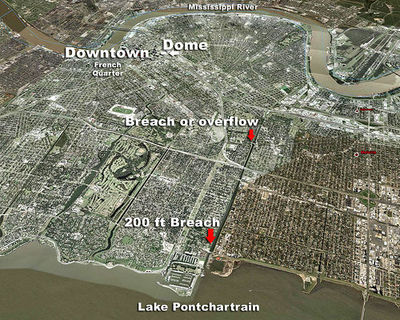
When Katrina hit, it drifted 15 miles to the east of where forecasters said it would strike. Therefore it wasn't quite the monster described. The storm passed through with relatively minor damage, it was the the storm surge from the Gulf that caused Lake Pontchartrain to rise three feet and the subsequent flooding.

Katrina hit early on Monday 29th August, the levees broke in three places - along the Industrial Canal, the 17th Street Canal, and the London Street Canal. (Click here for a Map )

The main storm surge from Hurricane Katrina washed into Lake Pontchartrain at around 7AM on August 29th when the counterclockwise motion of Katrina was pushing water from the Gulf of Mexico into the lake. Some are questioning the timeline of the levee failures, suggesting that there was a 21 hour discrepancy between the storm surge and the collapse of the levees .
This is not the case. The first levee broke just a few hours after the hurricane hit on the same morning.

This confusion may have arisen due to the fact that Homeland Security Chief Michael Chertoff has said that the levees broke overnight between Monday-Tuesday, and that he was not informed of this til midday Tuesday.

The breach of the 17th Street Canal levee resulted in the failure of a crucial pumping station nearby, according to a statement made by New Orleans Mayor Ray Nagin.

However, it seems that this exact scenario was expected and ignored. In an interview with New Orleans radio station local radio station WWL-AM, Nagin revealed how irate he was that this had been allowed to happen.

Nagin:
You know what really upsets me, Garland? We told everybody the importance of the 17th Street Canal issue. We said, "Please, please take care of this. We don't care what you do. Figure it out."WWL: Who'd you say that to?Nagin: Everybody: the governor, Homeland Security, FEMA. You name it, we said it. And they allowed that pumping station next to Pumping Station 6 to go under water.

Our sewage and water board people ... stayed there and endangered their lives. And what happened when that pumping station went down, the water started flowing again in the city, and it starting getting to levels that probably killed more people. In addition to that, we had water flowing through the pipes in the city. That's a power station over there. So there's no water flowing anywhere on the east bank of Orleans Parish. So our critical water supply was destroyed because of lack of action.

It has emerged though that some kind of work was carried out on the 17th Street Canal levee. Reports have suggested that the funding was not there to complete the job, but some work had been done:

"The Senate was seeking to restore some of the SELA funding cuts for 2006. But now it's too late. One project that a contractor had been racing to finish this summer was a bridge and levee job right at the 17th Street Canal, site of the main breach on Monday."

Of course we know that it was the White House that slashed funding for such projects in order to pump more money into the war in Iraq.


According to the New York Times, Dr. Shea Penland of the Pontchartrain Institute was surprised because the break was "along a section that was just upgraded. It did not have an earthen levee, it had a vertical concrete wall several feet thick."
It also seems that the broken section of the Industrial Canal levee was having "construction" work done on it recently.

New York Times science reporter Dr. Andrew Revkin has stated of the 17th Street Canal that

"officials and [Army Corps] engineers said that after they had found the widening gap in the concrete wall on the eastern side of the canal, they had no quick-response plan to repair it."

Lt. Gen. Carl A. Strock, commander of the corps, said "plugging the gap was a lower priority." The corps is directed by FEMA.

"It is FEMA who is really calling the shots and setting priorities here,"

Alfred C. Naomi, a senior project manager for the corps, was quoted in the same article as saying "there were still no clear hints why the main breach in the flood barriers occurred along the 17th Street Canal, normally a conduit for vast streams of water pumped out of the perpetually waterlogged city each day and which did not take the main force of the waves roiling the lake. He said that a low spot marked on survey charts of the levees near the spot that ruptured was unrelated and that the depression was where a new bridge crossed the narrow canal near the lakefront."

This would refute the speculation that a dip in the retaining levee or walls might have allowed water to slop over and start the collapse. So we have an unexplained crack in several feet of concrete. FEMA decided not to plug it and let the water flow until a US city was flooded and thousands had drowned.

Dynamite? History repeating itself?Many locals have come forward to suggest that the levees were breached on purpose by the authorities. Resident Andrea Garland, now re-located to Texas, wrote in her blog:

"Also heard that part of the reason our house flooded is they dynamited part of the levee after the first section broke - they did this to prevent Uptown (the rich part of town) from being flooded. Apparently they used too much dynamite, thus flooding part of the Bywater. So now I know who is responsible for flooding my house - not Katrina, but our government."

This scenario is not so crazy as it sounds, in fact this exact thing has happened before in the same city. In 1927, the Mississippi River broke its banks in 145 places, depositing water at depths of up to 30ft over 27,000 square miles of land.

The disaster changed American society, shifting hundreds of thousands of delta-dwelling blacks into northern cities and cementing the divisions and suspicions that benign neglect has ensured remain today. New Orleans’ (mainly white) business class pressurized the state to dynamite a levee upstream, releasing water into (mainly black) areas of the delta. Black workers were forced to work on flood relief at gunpoint, like slaves.

Two parishes, St. Bernard and Plaquemines, which had a combined population of 10,000, were destroyed. Just before Katrina, these parishes had about 10 times the 1927 population. Both parishes are now under many feet of water.

This information is covered in depth in a book by John M. Barry entitled Rising Tide: The Great Mississippi Flood of 1927 and how it Changed America, 1997 which has incidentally become heavily in demand after Katrina.

Furthermore, levees were also intentionally broke after Hurricane Betsy struck New Orleans in 1965, admittedly with less of an impact. The tactic of breaking the dikes is not uncommon, as this CNN report on China's flood plains highlights.

Engineers have now punched holes in several levees in parts of New Orleans where flood levels were higher than the water in drainage canals leading to Pontchartrain, in order to let water flow out.

Explosions?

There were reports of many explosions heard in New Orleans, officials say they were transformers blowing up. Total Information Analysis has reported a claim by intelligence expert Tom Heneghen that 25 earwitnesses cited explosions immediately before the levee breach.
Similar reports are now appearing in many web blogs:

"He also mentioned that right before the mass flood there was a loud sound like an explosion." -

News from St. Bernard

"I'll tell you the worst thing I've heard and I heard it from my mother. She said she heard several blasts - big booms - right before the levees broke. Several blasts and then all the water came pouring in." - aangirfan

Although these are obviously not authoritative sources of information, it is interesting to note how many local people are reporting this. So interesting in fact that the mainstream has picked up on it in places.

The Washington Post reported on the comments of a retired school teacher:

"Mullen has a schoolteacher's kindly demeanor, so it was jarring to hear him say he suspected that the levee breaks had somehow been engineered to keep the wealthy French Quarter and Garden District dry at the expense of poor black neighborhoods like the Lower Ninth Ward -- a suspicion I heard from many other black survivors."

The Globe and Mail is also carrying a similar story.
ABC World News Tonight carried a report which contained an interview with a local, who described how a floating barge had rammed the levee. The man seemed convinced that the levee was purposefully broken. A transcript of which has appeared on the net:

David Muir: “Was it solely the water that broke the levee? Or was it the force of this barge that now sits where homes once did? Joe Edwards says neither. People are so bitter, so disenfranchised in this neighborhood, they actually think the city did it, blowing up the levee to save richer neighborhoods, like the French Quarter.”Muir to Edwards as they stand on a bridge: “So you're convinced-”Edwards: “I knows it happened.”Muir: “-that they broke the levee on purpose?” Edwards: “They blew it.”Muir: “New Orleans’ Mayor says there's no credence to this.” Mayor Ray Nagin: “That storm was so powerful and it pushed so much water -- there's no way anyone could have calculated -- would dynamite the levee to have the kind of impact to save the French Quarter.”Muir concluded: “An LSU expert who looked at the video today, says that while the barge may have caused it, it was most likely the sheer force of the water that brought the levee, along the lower 9th ward, down.”


The mysterious barge story has also been reported by many other local residents.

"The evacuees who witnessed the barge striking the levee also want to know why the major media is not covering this story."

The London Observer carried an intriguing story of a man named Correll Williams, a 19-year-old meat cutter. The article states that:

"Williams only left his apartment after the authorities took the decision to flood his district in an apparent attempt to sluice out some of the water that had submerged a neighbouring district. Like hundreds of others he had heard the news of the decision to flood his district on the radio. The authorities had given people in the district until 5pm on Tuesday to get out - after that they would open the floodgates."

Some final intriguing footage reveals a journalist questioning former President Bill Clinton as to why many locals feel that the levees were purposefully broken.
This was during the press conference with Clinton and George Bush Snr announcing their combined "relief effort" for New Orleans. Ignore the first 15 minutes of sickening joking and backslapping between the two and skip to the last minute of footage. Upon hearing the question Clinton appears to be surprised and then simply walks off.

Click here to view the footage

Click here to listen to an MP3 of the last 30 seconds
We will track this story as it develops and cover any further updates.

Related:

FEMA Deliberately Sabotaging Hurricane Relief Efforts

Government Sabotage Of Hurricane Katrina Relief Efforts


Posted by Picasa

FEMA
La. outsource Katrina body count to firm implicated in body-dumping scandals

by Miriam Raftery

The Federal Emergency Management Agency has hired Kenyon International to set up a mobile morgue for handling bodies in Baton Rouge, Louisiana following Hurricane Katrina, RAW STORY has learned.

Kenyon is a subsidiary of Service Corporation International (SCI), a scandal-ridden Texas-based company operated by a friend of the Bush family. Recently, SCI subsidiaries have been implicated in illegally discarding and desecrating corpses.

Louisiana governor Katherine Blanco subsequently inked a contract with the firm after talks between FEMA and the firm broke down. Kenyon's original deal was secured by the Department of Homeland Security.

In other words, FEMA and then Blanco outsourced the body count from Hurricane Katrina -- which many believe the worst natural disaster in U.S. history -- to a firm whose parent company is known for its "experience" at hiding and dumping bodies.

The Menorah Gardens cemetery chain, owned by SCI, desecrated vaults, removed hundreds of bodies from two cemeteries in Florida and dumped the gruesome remains in woods frequented by wild hogs, investigators discovered in 2001. In one case, a backhoe was used to crack open a vault, remove corpses and make room for more dead bodies.

SCI paid $100 million to settle a lawsuit filed by outraged family members of the deceased.
A secretary at the lawfirm that sued SCI over the Florida cemetery scandals gasped when informed that FEMA had outsourced handling of Katrina victims' bodies to an SCI subsidiary.
"Oh, good lord!" she said.

Peter Hartmann, general manager of the Menorah Gardens Cemetery chain, was later found dead in his car from carbon monoxide poisoning outside his parents' home in an apparent suicide.

RAW STORY calls to FEMA were not returned.

Waltrip, chairman of SCI, is a longtime friend of Bush's father, former President George Herbert Walker Bush. The firm's political action committee donated $45,000 to George W. Bush's 1994 gubernatorial campaign.

The company also contributed more than $100,000 for construction of the George H.W. Bush presidential library.

"It is appalling that the Bush administration –- which has already badly bungled its response to hurricane Katrina –- would hire a company with a record of gross mismanagement of mortuary services," said Melanie Sloan, executive director of Citizens for Responsibility and Ethics, a Washington D.C.-based watchdog group. "I can only imagine that this decision was made because of President Bush's long-time friendship with the head of SCI, Robert Waltrip."

SCI also owned fifteen funeral homes named as defendants in a lawsuit filed on behalf of family members alleging "macabre mishandling, abuse and desecration of bodies" by Tri-State Crematory in Georgia. The lawsuit accused SCI-owned funeral homes of sending bodies to the unlicensed, unregulated crematorium, where never-incinerated corpses were found piled outdoors and stuffed in sheds in 2000.

Some vaults designed to hold one body each had 67 sets of human remains stuffed inside, investigators discovered. SCI was among the companies ordered to pay settlement fees to family members, a legal source has confirmed to RAW STORY.

Kenyon bills itself as the world's leading disaster management company. It provided morgue support services following the 9/11 plane crash in Pennsylvania and the Asian tsunami.
As North America's largest funeral and cemetery company, SCI operates 1,500 mortuaries and cemeteries nationwide.

The company's website claims the firm is dedicated to "compassionately supporting families at difficult times, celebrating the significance of lives that have been lived, and preserving memories that transcend generations, with dignity and honor."

SCI was also involved in an earlier scandal in Texas. Eliza May, former Texas Funeral Service Commission Director, filed a lawsuit accusing George W. Bush, then Governor, of obstructing an investigation into SCI license violations. May was fired following a dispute with Waltrip.

Waltrip and an SCI lobbyist met with Governor Bush's chief of staff, Joe Allbaugh (Allbaugh was later appointed head of FEMA after Bush became President, but left to become a lobbyist representing Halliburton, among other corporate clients).

According to Newsweek, Bush stopped by and said to Waltrip, "Hey, Bobby, are those people still messing with you?"

May, a Democrat, sought to force Bush to testify in the case, but in August 1999, a Texas judge tossed out a subpoena issued by May's lawyers for Bush to give a deposition. Bush, who was not a defendant, called May's claims "frivolous" and denied knowing the circumstances of her ouster.

In 1999, when Bush was gearing up to run for the presidency, Texas Governor Rick Perry approved a settlement for May. SCI paid $55,000; the state of Texas shelled out the balance without admitting wrongdoing in May's termination.

Jennifer Crider, spokeswoman for House Minority Leader Nancy Pelosi (D-Calif.), expressed concern over FEMA's choice of an SCI subsidiary and questioned whether the selection was made through a no-bid process.

"The tragedy in the Gulf States must not be compounded by disrespecting those who have died," Crider told RAW STORY. "It's critical that government contracts be subjected to scrutiny to ensure that there has been no fraud or abuse of taxpayer money or interest."
Democrats have called for formation of an anti-fraud commission to investigate no-bid contracts awarded in relation to Hurricane Katrina, she added.

Why FEMA chose to outsource mortuary services to a paid contractor is also mystery to Dan Buckner, co-owner of the Gowen-Smith Chapel in the Gulf area. Buckner had planned to serve with the Disaster Mortuary Operational Responses Team, which reportedly told Buckner's partner, Gary Hicks of Paducah, KY, to expect up to 40,000 deaths from Katrina in Louisiana and Mississippi.

Upon learning of Kenyon’s contract, Buckner expressed puzzlement. He told the Shelbyville Times-Gazette, "Volunteers would have gone at no charge."

Clarification: After FEMA began working with Kenyon, they were subsequently contracted by Louisiana Governor Blanco. It was Louisiana that signed a formal contract.

RAW

Posted by Picasa

Saturday, September 17, 2005

Willie Lynch Letter.......Full Version

Willie Lynch letter: The Making of a Slave

By FinalCall.com NewsUpdated Aug 22, 2005, 01:05 am

This speech was delivered by Willie Lynch on the bank of the James River in the colony of Virginia in 1712. Lynch was a British slave owner in the West Indies. He was invited to the colony of Virginia in 1712 to teach his methods to slave owners there. The term “lynching” is derived from his last name.

[beginning of the Willie Lynch Letter]

Greetings,

Gentlemen. I greet you here on the bank of the James River in the year of our Lord one thousand seven hundred and twelve.

First, I shall thank you, the gentlemen of the Colony of Virginia, for bringing me here. I am here to help you solve some of your problems with slaves. Your invitation reached me on my modest plantation in the West Indies, where I have experimented with some of the newest, and still the oldest, methods for control of slaves.

Ancient Rome would envy us if my program is implemented. As our boat sailed south on the James River, named for our illustrious King, whose version of the Bible we cherish, I saw enough to know that your problem is not unique. While Rome used cords of wood as crosses for standing human bodies along its highways in great numbers, you are here using the tree and the rope on occasions. I caught the whiff of a dead slave hanging from a tree, a couple miles back.

You are not only losing valuable stock by hangings, you are having uprisings, slaves are running away, your crops are sometimes left in the fields too long for maximum profit, you suffer occasional fires, your animals are killed. Gentlemen, you know what your problems are; I do not need to elaborate. I am not here to enumerate your problems, I am here to introduce you to a method of solving them. In my bag here, I HAVE A FULL PROOF METHOD FOR CONTROLLING YOUR BLACK SLAVES.

I guarantee every one of you that, if installed correctly, IT WILL CONTROL THE SLAVES FOR AT LEAST 300 HUNDREDS YEARS. My method is simple. Any member of your family or your overseer can use it. I HAVE OUTLINED A NUMBER OF DIFFERENCES AMONG THE SLAVES; AND I TAKE THESE DIFFERENCES AND MAKE THEM BIGGER. I USE FEAR, DISTRUST AND ENVY FOR CONTROL PURPOSES.

These methods have worked on my modest plantation in the West Indies and it will work throughout the South. Take this simple little list of differences and think about them. On top of my list is “AGE,” but it’s there only because it starts with an “a.” The second is “COLOR” or shade. There is INTELLIGENCE, SIZE, SEX, SIZES OF PLANTATIONS, STATUS on plantations, ATTITUDE of owners, whether the slaves live in the valley, on a hill, East, West, North, South, have fine hair, course hair, or is tall or short.

Now that you have a list of differences, I shall give you an outline of action, but before that, I shall assure you that DISTRUST IS STRONGER THAN TRUST AND ENVY STRONGER THAN ADULATION, RESPECT OR ADMIRATION. The Black slaves after receiving this indoctrination shall carry on and will become self-refueling and self-generating for HUNDREDS of years, maybe THOUSANDS.

Don’t forget, you must pitch the OLD black male vs. the YOUNG black male, and the YOUNG black male against the OLD black male. You must use the DARK skin slaves vs. the LIGHT skin slaves, and the LIGHT skin slaves vs. the DARK skin slaves. You must use the FEMALE vs. the MALE, and the MALE vs. the FEMALE.

You must also have white servants and overseers [who] distrust all Blacks. But it is NECESSARY THAT YOUR SLAVES TRUST AND DEPEND ON US. THEY MUST LOVE, RESPECT AND TRUST ONLY US. Gentlemen, these kits are your keys to control. Use them. Have your wives and children use them, never miss an opportunity.

IF USED INTENSELY FOR ONE YEAR, THE SLAVES THEMSELVES WILL REMAIN PERPETUALLY DISTRUSTFUL.

Thank you gentlemen.”

LET’S MAKE A SLAVE

It was the interest and business of slave holders to study human nature, and the slave nature in particular, with a view to practical results. I and many of them attained astonishing proficiency in this direction. They had to deal not with earth, wood and stone, but with men and, by every regard, they had for their own safety and prosperity they needed to know the material on which they were to work, conscious of the injustice and wrong they were every hour perpetuating and knowing what they themselves would do. Were they the victims of such wrongs?

They were constantly looking for the first signs of the dreaded retribution. They watched therefore with skilled and practiced eyes, and learned to read with great accuracy, the state of mind and heart of the slave, through his sable face. Unusual sobriety, apparent abstractions, sullenness and indifference indeed, any mood out of the common was afforded ground for suspicion and inquiry. Frederick Douglas LET’S MAKE A SLAVE is a study of the scientific process of man-breaking and slave-making. It describes the rationale and results of the Anglo Saxons’ ideas and methods of insuring the master/slave relationship.

LET’S MAKE A SLAVE “The Original and Development of a Social Being Called ‘The Negro.’” Let us make a slave. What do we need? First of all, we need a black nigger man, a pregnant nigger woman and her baby nigger boy. Second, we will use the same basic principle that we use in breaking a horse, combined with some more sustaining factors. What we do with horses is that we break them from one form of life to another; that is, we reduce them from their natural state in nature. Whereas nature provides them with the natural capacity to take care of their offspring, we break that natural string of independence from them and thereby create a dependency status, so that we may be able to get from them useful production for our business and pleasure.

CARDINAL PRINCIPLES FOR MAKING A NEGRO

For fear that our future generations may not understand the principles of breaking both of the beast together, the nigger and the horse. We understand that short range planning economics results in periodic economic chaos; so that to avoid turmoil in the economy, it requires us to have breadth and depth in long range comprehensive planning, articulating both skill sharp perceptions. We lay down the following principles for long range comprehensive economic planning. Both horse and niggers [are] no good to the economy in the wild or natural state.

Both must be BROKEN and TIED together for orderly production. For orderly future, special and particular attention must be paid to the FEMALE and the YOUNGEST offspring. Both must be CROSSBRED to produce a variety and division of labor. Both must be taught to respond to a peculiar new LANGUAGE. Psychological and physical instruction of CONTAINMENT must be created for both. We hold the six cardinal principles as truth to be self-evident, based upon following the discourse concerning the economics of breaking and tying the horse and the nigger together, all inclusive of the six principles laid down above.

NOTE: Neither principle alone will suffice for good economics. All principles must be employed for orderly good of the nation. Accordingly, both a wild horse and a wild or natur[al] nigger is dangerous even if captured, for they will have the tendency to seek their customary freedom and, in doing so, might kill you in your sleep. You cannot rest. They sleep while you are awake, and are awake while you are asleep. They are DANGEROUS near the family house and it requires too much labor to watch them away from the house. Above all, you cannot get them to work in this natural state. Hence, both the horse and the nigger must be broken; that is breaking them from one form of mental life to another.

KEEP THE BODY, TAKE THE MIND! In other words, break the will to resist. Now the breaking process is the same for both the horse and the nigger, only slightly varying in degrees. But, as we said before, there is an art in long range economic planning. YOU MUST KEEP YOUR EYE AND THOUGHTS ON THE FEMALE and the OFFSPRING of the horse and the nigger. A brief discourse in offspring development will shed light on the key to sound economic principles. Pay little attention to the generation of original breaking, but CONCENTRATE ON FUTURE GENERATION.

Therefore, if you break the FEMALE mother, she will BREAK the offspring in its early years of development; and when the offspring is old enough to work, she will deliver it up to you, for her normal female protective tendencies will have been lost in the original breaking process. For example, take the case of the wild stud horse, a female horse and an already infant horse and compare the breaking process with two captured nigger males in their natural state, a pregnant nigger woman with her infant offspring. Take the stud horse, break him for limited containment. Completely break the female horse until she becomes very gentle, whereas you or anybody can ride her in her comfort. Breed the mare and the stud until you have the desired offspring.

Then, you can turn the stud to freedom until you need him again. Train the female horse whereby she will eat out of your hand, and she will in turn train the infant horse to eat out of your hand, also. When it comes to breaking the uncivilized nigger, use the same process, but vary the degree and step up the pressure, so as to do a complete reversal of the mind. Take the meanest and most restless nigger, strip him of his clothes in front of the remaining male niggers, the female, and the nigger infant, tar and feather him, tie each leg to a different horse faced in opposite directions, set him afire and beat both horses to pull him apart in front of the remaining niggers. The next step is to take a bullwhip and beat the remaining nigger males to the point of death, in front of the female and the infant. Don’t kill him, but PUT THE FEAR OF GOD IN HIM, for he can be useful for future breeding.

THE BREAKING PROCESS OF THE AFRICAN WOMAN

Take the female and run a series of tests on her to see if she will submit to your desires willingly. Test her in every way, because she is the most important factor for good economics. If she shows any sign of resistance in submitting completely to your will, do not hesitate to use the bullwhip on her to extract that last bit of [b----] out of her. Take care not to kill her, for in doing so, you spoil good economics. When in complete submission, she will train her offsprings in the early years to submit to labor when they become of age.

Understanding is the best thing. Therefore, we shall go deeper into this area of the subject matter concerning what we have produced here in this breaking process of the female nigger. We have reversed the relationship; in her natural uncivilized state, she would have a strong dependency on the uncivilized nigger male, and she would have a limited protective tendency toward her independent male offspring and would raise male offsprings to be dependent like her. Nature had provided for this type of balance. We reversed nature by burning and pulling a civilized nigger apart and bullwhipping the other to the point of death, all in her presence.

By her being left alone, unprotected, with the MALE IMAGE DESTROYED, the ordeal caused her to move from her psychologically dependent state to a frozen, independent state. In this frozen, psychological state of independence, she will raise her MALE and female offspring in reversed roles. For FEAR of the young male’s life, she will psychologically train him to be MENTALLY WEAK and DEPENDENT, but PHYSICALLY STRONG. Because she has become psychologically independent, she will train her FEMALE offsprings to be psychologically independent. What have you got? You’ve got the nigger WOMAN OUT FRONT AND THE nigger MAN BEHIND AND SCARED.

This is a perfect situation of sound sleep and economics. Before the breaking process, we had to be alertly on guard at all times. Now, we can sleep soundly, for out of frozen fear his woman stands guard for us. He cannot get past her early slave-molding process. He is a good tool, now ready to be tied to the horse at a tender age. By the time a nigger boy reaches the age of sixteen, he is soundly broken in and ready for a long life of sound and efficient work and the reproduction of a unit of good labor force. Continually through the breaking of uncivilized savage niggers, by throwing the nigger female savage into a frozen psychological state of independence, by killing the protective male image, and by creating a submissive dependent mind of the nigger male slave, we have created an orbiting cycle that turns on its own axis forever, unless a phenomenon occurs and re-shifts the position of the male and female slaves. We show what we mean by example. Take the case of the two economic slave units and examine them close.

THE NEGRO MARRIAGE

We breed two nigger males with two nigger females. Then, we take the nigger male away from them and keep them moving and working. Say one nigger female bears a nigger female and the other bears a nigger male; both nigger females—being without influence of the nigger male image, frozen with a independent psychology—will raise their offspring into reverse positions. The one with the female offspring will teach her to be like herself, independent and negotiable (we negotiate with her, through her, by her, negotiates her at will).

The one with the nigger male offspring, she being frozen subconscious fear for his life, will raise him to be mentally dependent and weak, but physically strong; in other words, body over mind. Now, in a few years when these two offsprings become fertile for early reproduction, we will mate and breed them and continue the cycle. That is good, sound and long range comprehensive planning.

WARNING: POSSIBLE INTERLOPING NEGATIVES

Earlier, we talked about the non-economic good of the horse and the nigger in their wild or natural state; we talked out the principle of breaking and tying them together for orderly production. Furthermore, we talked about paying particular attention to the female savage and her offspring for orderly future planning, then more recently we stated that, by reversing the positions of the male and female savages, we created an orbiting cycle that turns on its own axis forever unless a phenomenon occurred and reshifts positions of the male and female savages.

Our experts warned us about the possibility of this phenomenon occurring, for they say that the mind has a strong drive to correct and re-correct itself over a period of time if it can touch some substantial original historical base; and they advised us that the best way to deal with the phenomenon is to shave off the brute’s mental history and create a multiplicity of phenomena of illusions, so that each illusion will twirl in its own orbit, something similar to floating balls in a vacuum. This creation of multiplicity of phenomena of illusions entails the principle of crossbreeding the nigger and the horse as we stated above, the purpose of which is to create a diversified division of labor; thereby creating different levels of labor and different values of illusion at each connecting level of labor.

The results of which is the severance of the points of original beginnings for each sphere illusion. Since we feel that the subject matter may get more complicated as we proceed in laying down our economic plan concerning the purpose, reason and effect of crossbreeding horses and niggers, we shall lay down the following definition terms for future generations. Orbiting cycle means a thing turning in a given path. Axis means upon which or around which a body turns. Phenomenon means something beyond ordinary conception and inspires awe and wonder. Multiplicity means a great number. Means a globe.

Crossbreeding a horse means taking a horse and breeding it with an ass and you get a dumb, backward, ass long-headed mule that is not reproductive nor productive by itself. Crossbreeding niggers mean taking so many drops of good white blood and putting them into as many nigger women as possible, varying the drops by the various tone that you want, and then letting them breed with each other until another circle of color appears as you desire. What this means is this: Put the niggers and the horse in a breeding pot, mix some asses and some good white blood and what do you get?

You got a multiplicity of colors of ass backward, unusual niggers, running, tied to backward ass long-headed mules, the one productive of itself, the other sterile. (The one constant, the other dying, we keep the nigger constant for we may replace the mules for another tool) both mule and nigger tied to each other, neither knowing where the other came from and neither productive for itself, nor without each other.

CONTROLLED LANGUAGE

Crossbreeding completed, for further severance from their original beginning, WE MUST COMPLETELY ANNIHILATE THE MOTHER TONGUE of both the new nigger and the new mule, and institute a new language that involves the new life’s work of both. You know language is a peculiar institution. It leads to the heart of a people. The more a foreigner knows about the language of another country the more he is able to move through all levels of that society.

Therefore, if the foreigner is an enemy of the country, to the extent that he knows the body of the language, to that extent is the country vulnerable to attack or invasion of a foreign culture. For example, if you take a slave, if you teach him all about your language, he will know all your secrets, and he is then no more a slave, for you can’t fool him any longer, and BEING A FOOL IS ONE OF THE BASIC INGREDIENTS OF ANY INCIDENTS TO THE MAINTENANCE OF THE SLAVERY SYSTEM.

For example, if you told a slave that he must perform in getting out “our crops” and he knows the language well, he would know that “our crops” didn’t mean “our crops” and the slavery system would break down, for he would relate on the basis of what “our crops” really meant. So you have to be careful in setting up the new language; for the slaves would soon be in your house, talking to you as “man to man” and that is death to our economic system. In addition, the definitions of words or terms are only a minute part of the process. Values are created and transported by communication through the body of the language.

A total society has many interconnected value systems. All the values in the society have bridges of language to connect them for orderly working in the society. But for these language bridges, these many value systems would sharply clash and cause internal strife or civil war, the degree of the conflict being determined by the magnitude of the issues or relative opposing strength in whatever form.

For example, if you put a slave in a hog pen and train him to live there and incorporate in him to value it as a way of life completely, the biggest problem you would have out of him is that he would worry you about provisions to keep the hog pen clean, or the same hog pen and make a slip and incorporate something in his language whereby he comes to value a house more than he does his hog pen, you got a problem. He will soon be in your house.

Additional Note: “Henty Berry, speaking in the Virginia House of Delegates in 1832, described the situation as it existed in many parts of the South at this time: “We have, as far as possible, closed every avenue by which light may enter their (the slaves) minds. If we could extinguish the capacity to see the light, our work would be complete; they would then be on a level with the beasts of the field and we should be safe. I am not certain that we would not do it, if we could find out the process and that on the plea of necessity.” From Brown America, The story of a New Race by Edwin R. Embree. 1931 The Viking Press.

© Copyright 2005 FCN Publishing, FinalCall.com

http://www.finalcall.com/artman/publish/article_2167.shtml

Kanye

Kane West speaking the truth

http://www.godlikeproductions.com/scans/Kayne-West.wmv

Telling the truth is easy.

Living with the consequences can be difficult.

Shoot To Kill ?????

Troops told 'shoot to kill' in New Orleans

Texas game wardens watch over people who were caught using a mail truck to try to escape New Orleans. They were freed but forced to continue on foot. Reuters

A detachment of 300 National Guard troops have landed in anarchic New Orleans with the authorisation to shoot and kill "hoodlums", Louisiana Governor Kathleen Blanco says.

Thousands of troops have struggled to counter armed looters and help tens of thousands of refugees flee New Orleans, where chaos reigns three days after Hurricane Katrina.

Top officials have confirmed that the storm killed thousands of people and have made a desperate plea for help to restore order to New Orleans and the surrounding region.

"Three hundred of the Arkansas National Guard have landed in the city of New Orleans," Ms Blanco said.

"These troops are fresh back from Iraq, well trained, experienced, battle-tested and under my orders to restore order in the streets.

"They have M-16s and they are locked and loaded.

"These troops know how to shoot and kill and they are more than willing to do so if necessary and I expect they will."

Colonel Henry Whitehorn of the Louisiana State Police said the law and order situation in the city was "bad".

But he said anarchic conditions around the Superdome stadium and central business district where up to 20,000 refugees had been sheltering were "stabilising".

He admitted that a number of police officers who had lost everything in flooding after Hurricane Katrina had handed in their badges, unwilling to take the fight to looters.

'War zone'

Four days after the hurricane hit, New Orleans was still plagued by gun battles and rapes, with gangs of looters and carjackers roving the streets as bodies were left lying by the roadside.
Many people have spent four days without proper food, water and sanitation and endured nights of lawless blackout.

Residents reported survivors dropping dead in shelters. Hospitals were evacuated after power ran out.

"This is a war zone," said Melissa Murray, 32, a Louisiana state corrections officer helping in the relief effort.

A National Guardsman was shot outside the Superdome and a shot was also fired at a Chinook helicopter taking part in the operation to move refugees out of the stadium, officials said.

Two children were reportedly raped at the stadium.

New Orleans Mayor Ray Nagin issued an urgent plea for help for up to 20,000 refugees stuck in the convention centre, which he said was "unsanitary and unsafe" and running out of supplies.

"This is a desperate SOS," Mr Nagin said in a statement released through CNN television.
Ms Blanco said up to 300,000 survivors might still be stuck in disaster areas in the state and at least 40,000 uniformed troops were needed for New Orleans alone.

Although no precise death toll was available, Ms Blanco and Louisiana Senator Mary Landrieu said several thousand people were believed to have been killed by Katrina.

'National disgrace'

As US Congress was in the process of passing a $14 billion plan for emergency disaster relief, the head of New Orleans's emergency operations, Terry Ebbert, called the response effort "a national disgrace".

Mr Ebert said the Federal Emergency Management Agency had been in the city for three days "yet there is no command and control".

"We can send massive amounts of aid to tsunami victims but we can't bail out the city of New Orleans," he said.

Thomas Jessie, a 31-year-old roofer, vented his fear and anger after spending a night in the squalor of the convention centre with no National Guard nor Red Cross workers in sight.

"We got dead bodies sitting next to us for days. I feel like I am going to die. People are going to kill you for water," Mr Jessie said.

"This is America, I don't understand the lack of communications between the authorities and the people," he said. "It is disgusting, we feel we have been forgotten."

Officials said the floodwaters were to blame for slow progress.

"Let me emphasise, from the very beginning, and as we speak, rescue operations have continued and are continuing in full force," said Homeland Security Chief Michael Chertoff.
President George W Bush vowed "zero tolerance" for armed gangs and profiteers.

Mr Bush, criticised for his tardy response to the disaster, cranked up the Government's relief machinery and was to tour hurricane-damaged areas of Louisiana, Mississippi and Alabama on Friday.

He also tapped his father, former president George Bush Snr, and former president Bill Clinton to lead fundraising efforts for the victims of the hurricane.

The President also appealed for Americans to conserve car fuel for the next few weeks. But US petrol stations saw panic buying and lengthening queues.

www.abcnews.com

New Orleans High School Students Write........

The Neighborhood Story Project......

is a community documentary program in New Orleans, Louisiana. Based out of John McDonogh Senior High, we teach high school students how to write books about their neighborhoods. Through creative non-fiction, photography, and in-depth interviews, they then create detailed portraits of their communities. In June of 2005, we published five books that looked at the city from different vantage points. These books were celebrated with block parties in the neighborhoods and were the second best selling books at independent bookstores in New Orleans before Hurricane Katrina. In the aftermath of the destruction, we are in the process of re-envisioning our work and our city. Please stay posted for more information.

After the Flood

Surprising stories from survivors of Hurricane Katrina in New Orleans. A woman who was at the convention center talks about some things she says were widely misreported and misunderstood. Two people explain how armed police from Gretna actually prevented them from leaving New Orleans at the height of the crisis. A teenager talks about what it actually feels like to go without water for two days. And more.

One of the teenagers interviewed in "After the Flood," Ashley Nelson, is the author of an amazing book called The Combination, about her neighborhood in New Orleans. All the copies that were available are now underwater. But The Neighborhood Stories Project, which collaborated with Ashley and several other New Orleans teenagers on books about their neighborhoods, plans to print another run as soon as possible.

http://www.neighborhoodstoryproject.org/

Thank you for the link Afropick...

They Blew that Dayum Levee......

VIDEO: Earwitness tells ABC explosives blew Industrial Canal levee

Total411.info has obtained video of an ABC News report featuring an earwitness to explosives used to destroy the Industrial Canal in New Orleans. Here's the video, and here's the transcript:

DAVID MUIR, ABC NEWS:
This is the actual levee that runs along the canal on the eastern side of the city. And when the hurricane hit, the water came through at such force, it was apparently too much. You can see the massive breach here, and when you look around the corner you can see what the water did to the Lower Ninth Ward. It compleetley destoryed neighborhoods.

JOE EDWARDS, JR., 9TH WARD RESIDENT: I heard something go

BOOM!MUIR: Joe Edwards rushed to get himself and as many neighbors as possible into his truck. They drove to this bridge, where they've been living ever since

EDWARDS: My house broke in half. My mother's house just disintegrated. It was a brick house. All the houses down there floated down the street like somebody's guiding 'em

MUIR: Was it solely the water that broke the levee, or was it the force of this barge that now sits where homes once did? Joe Edwards says neither. People are so bitter, so disenfranchised in this neighborhood, they actually think the city did it, blowing up the levee to save richer neighborhoods like the French Quarter.

MUIR: So you're convinced . . .

EDWARDS: I know this happened!

MUIR: . . . they broke the levee on purpose?

EDWARDS: They blew it!

MUIR: New Orleans' mayor says there's no credence to this.

NEW ORLEANS MAYOR RAY NAGIN: That storm was so powerful and it pushed so much water, there's no way anyone could have calculated what levee to dynamite to have the kind of impact to save the French Quarter.

MUIR: An LSU expert who looked at the video today says, while the barge may have caused it, it was most likely the sheer force of the water that brought the levee along the Lower Ninth Ward down.--

(NOTE: It is not clear at all that blowing the Industrial Canal could have "saved" the Quarter, or that the Quarter was in danger at all.)

Watch and listen for yourself:
http://www.total411.info/2005/09/video-earwitness-tells-abc-explosives.html